
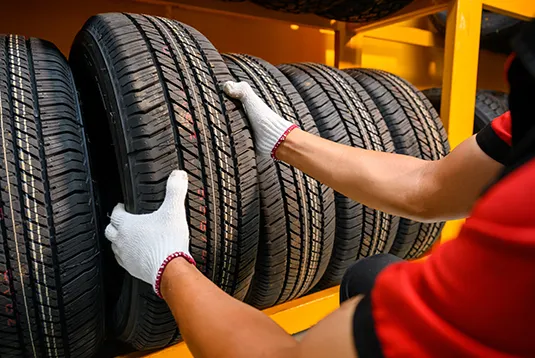
Maintaining your semi-truck tires isn’t just necessary for fleet safety. It’s also critical for maximizing vehicle performance and minimizing costs. Your tires are the only thing touching the road, and any failure can pose enormous hazards and cost your fleet significant time and money.
Below, we break down some of the most common questions about semi-truck tire maintenance and offer tips for getting the most out of your wheels.
Why is Semi-Truck Tire Maintenance Important?
First and foremost, maintaining your truck’s tires is important for ensuring the safety of yourself, your drivers and everyone on the road.
Proper maintenance ensures better traction and improved handling, giving you more control on the road (especially in unfavorable weather conditions) while reducing the risk of blowouts and accidents.
Beyond safety, however, regular tire maintenance is also critical for minimizing your fleet’s operating costs. Over time, repeated heavy loads and long hours on the road can reduce your tires’ lifespan and force your engine to work harder, leading to additional vehicle issues and reduced fuel efficiency.
To avoid unexpected downtime, prevent costly repairs and get the most out of your tires, your fleet should schedule regular preventative tire maintenance.
How Often Should Semi-Truck Tires Be Replaced?
How often you get your tires replaced will depend on a few factors, such as:
- Age (average tire lifespan is 3 – 6 years)
- Milage
- Usage
- Physical damage
- Prior maintenance
- Daily operating conditions
The most important indicator that your tires need replacing is tread depth. Federal guidelines from the Department of Transportation (DOT) require that all steer tires get replaced when tread depth reaches 4/32 inches, and all drive and trailer tires be replaced when tread depth reaches 2/32 inches. Failing to do so increases the risk of blowouts and decreases traction.
How Do I Check Tread Depth on a Semi-Truck?
There are a couple of different, simple methods you can use to check your tires’ tread depth.
Use a Tire Gauge
This is the primary way to check your tread depth and provides the most accurate reading. Here’s how it works:
- Insert the gauge probe into the tread groove.
- Ensure the gauge is perpendicular to the tire.
- Press the gauge's base flat against the tread surface.
- Read the measurement.
- Check multiple locations around the tire to get a more accurate reading.
Use the Penny/Quarter Test
If you don’t have a tire tread depth gauge, you can use a quarter to perform a quick check for steer tires, or a penny for all other types of tires.
- Hold the coin so that Lincoln's or Washington’s head faces you and points down.
- Choose a tread groove and insert the coin.
- If the tread covers any part of the head, your tires are probably above the minimum tread depth.
- If the top of the head is fully visible, your tread depth likely does not meet the requirements.
While this test can be useful in a pinch, it is not nearly as precise as using an actual depth gauge. Before deciding whether to repair or replace your tires, be sure to perform a proper test with a tire gauge.
How Often Should Semi-Truck Tires be Rotated?
While intervals will vary, most fleets rotate steer tires every 30,000 – 50,000 miles, and drive tires typically every 40,000 – 60,000 miles.
Ultimately, how frequently you rotate your tires also depends on different factors. If your fleet runs heavy loads or frequently drives routes with rough surfaces, you should shorten rotation intervals by about 20 – 30%.
Be sure to monitor your tires’ tread depth and wear patterns, as this is more important than following a strict mileage schedule.
Should I Get My Tires Repaired or Replaced?
The decision to repair or replace your semi-truck tires will depend on whether the tires are structurally sound and have sufficient tread depth.
When to Repair Your Tires
Tires can often be repaired in the event of minor damage, as long as tread depth remains acceptable and doesn’t compromise the tire’s structure. This can include:
- Minor cuts
- Small punctures (located in the tread area)
- Surface cracks
- Damage that has not exposed cords or steel belts
- Isolated damage that can be fixed using patch-plug repair
When to Replace Your Tires
On the other hand, you will need to replace your tires if they fall below acceptable safety standards or show signs of structural failure. Some signs to look for include:
- Tire tread depth below legal limits
- Sidewall cuts, cracks, bulges or bubbles
- Exposed cords or steel belts
- Tread or sidewall separation
- Casing deterioration
- Excessive tire age
Tire and Maintenance Services
Amid record-high costs, the decision to repair or replace your tires is a significant one. By joining the RTS Truck Care Program, you get access to the best deals on new and retread tires from top brands like Michelin, Bridgestone and more. Plus, you can keep your truck’s tires running strong with preventative maintenance discounts at over 3,000 service centers nationwide.
Interested in joining our industry-leading truck care program? Fill out the form and an RTS representative will be in touch shortly!